
Creating an effective learning course involves much more than writing lessons and adding attractive visuals. An instructional design company must make sure that every part of a learning experience is accurate, understandable, engaging, accessible, and useful to the intended audience. Quality testing helps identify problems before learners encounter them.
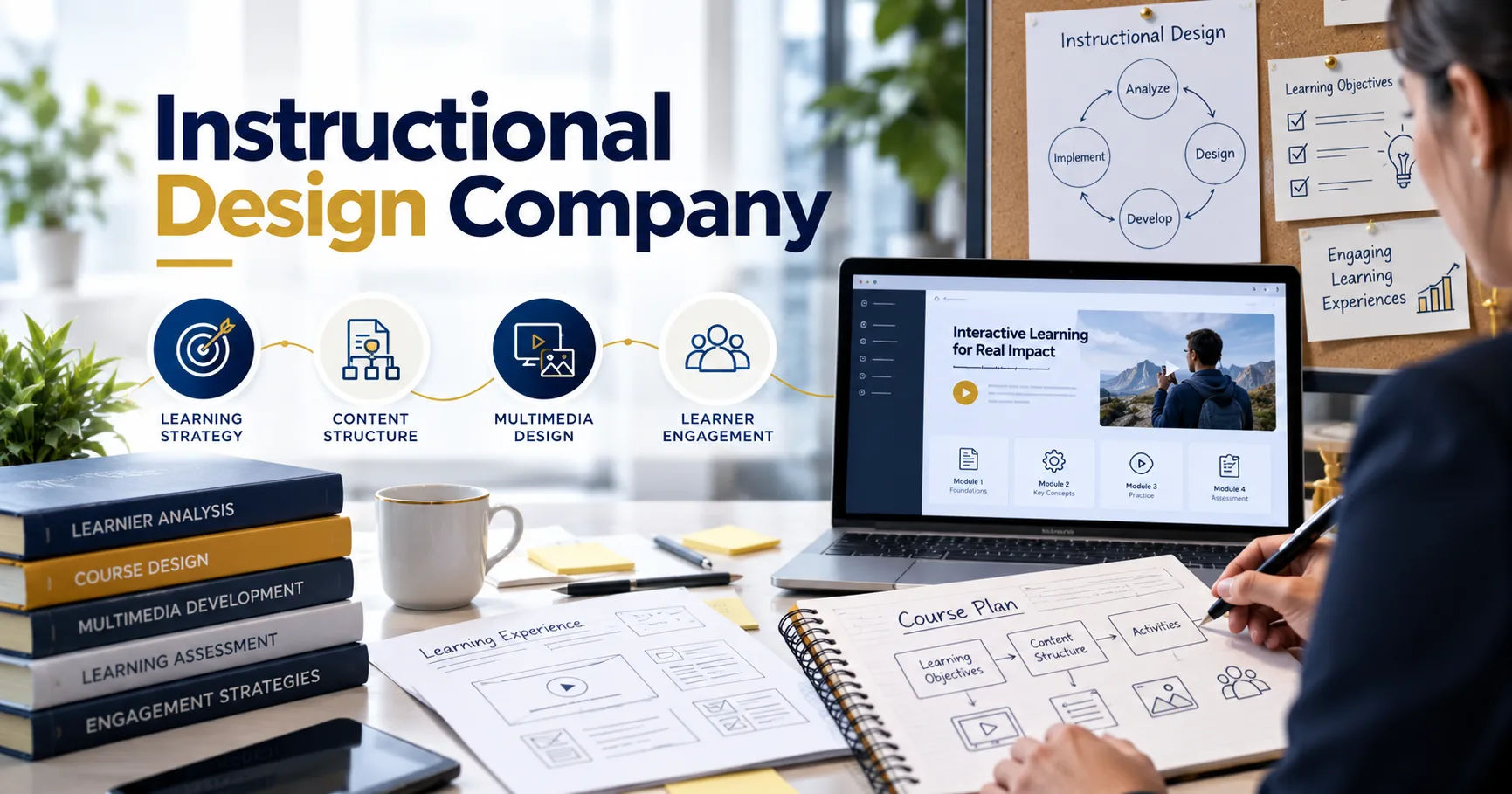
A strong quality process examines everything from learning objectives and content accuracy to assessments, navigation, multimedia, and technical performance. It also checks whether learners can actually achieve the outcomes the course promises.
For organizations investing in employee training, educational programs, compliance courses, or digital learning, quality testing is especially important. A course that looks professional but contains confusing instructions or poorly designed assessments may fail to produce meaningful learning.
This guide explains how an instructional design company tests quality, which areas are evaluated, what the testing process usually involves, and why continuous improvement is essential.
What Does Quality Mean in Instructional Design?
Quality in instructional design means that a learning experience successfully helps its intended audience understand information and apply what they have learned.
Quality is not limited to visual appearance. A course can have impressive graphics and animations while still being ineffective if the information is inaccurate or the learning activities do not support the objectives.
A quality course usually has several characteristics:
- Clear learning objectives
- Accurate and relevant information
- Logical organization
- Appropriate instructional methods
- Useful practice activities
- Effective assessments
- Accessible design
- Reliable technology
- Consistent language and visuals
- A positive learner experience
An instructional design company typically evaluates these areas before a course is released.
Why Quality Testing Matters
Quality testing protects both the organization creating the training and the people who will use it.
If errors remain unnoticed, learners may receive incorrect information. In workplace training, this can create serious problems, particularly when courses involve safety, regulations, technical procedures, or professional standards.
Testing also improves learner confidence. When instructions are clear and the course functions smoothly, learners can concentrate on the subject instead of struggling with the technology.
Another important benefit is efficiency. Finding a problem during development is generally easier than correcting it after thousands of learners have already completed the course.
Reviewing Learning Objectives
Checking Alignment
One of the first areas an instructional design company reviews is the connection between learning objectives, course content, activities, and assessments.
A learning objective should explain what learners are expected to know or do after completing the lesson.
For example, an objective might require learners to identify workplace hazards. If the final assessment only asks them to memorize definitions, there is a mismatch.
Quality reviewers check whether the activities and assessments actually measure the stated objectives.
Making Objectives Measurable
Objectives should use clear and observable actions.
Words such as "understand" or "know" can sometimes be difficult to measure directly. More specific verbs such as "identify," "explain," "compare," "demonstrate," or "create" make evaluation easier.
Reviewers examine whether objectives are realistic for the learner's level, course duration, and subject matter.
Checking Content Accuracy
Subject Matter Review
Content accuracy is one of the most important parts of quality assurance.
An instructional design company may work with subject matter experts to verify facts, procedures, terminology, examples, statistics, and technical information.
The instructional designer understands how to teach the material, while the subject matter expert provides specialized knowledge.
Both perspectives are valuable.
Checking Relevance
Information should also be relevant to the learner.
A course can contain technically correct information but still be ineffective if much of the material is outdated or unrelated to the learner's responsibilities.
Reviewers may remove unnecessary details and update examples to reflect current workplace or educational situations.
Checking Sources
Depending on the project, reviewers may also verify references and supporting sources.
This is particularly important for courses that depend on regulations, scientific information, industry standards, or institutional policies.
Evaluating Instructional Structure
A well-designed course should have a logical flow.
The learner should understand where the course begins, what is being taught, how different concepts connect, and what comes next.
An instructional design company may review the sequence of lessons to determine whether learners receive foundational information before being asked to complete more advanced tasks.
For example, a course about financial analysis might introduce basic financial concepts before asking learners to interpret complex reports.
Poor sequencing can create unnecessary cognitive load.
Testing Assessments
Assessments provide evidence of whether learning objectives have been achieved.
Reviewing Question Quality
Quality reviewers examine assessment questions for clarity, accuracy, and relevance.
A good question should test the intended knowledge or skill rather than confusing learners with complicated wording.
Incorrect answers should also be plausible enough to demonstrate whether the learner understands the material.
Avoiding Ambiguous Questions
An ambiguous question may have multiple reasonable answers.
Reviewers look for unclear wording, unnecessary complexity, grammatical problems, and missing information.
They also verify that the correct answer is genuinely supported by the course content.
Matching Assessments to Objectives
Assessment methods should match the skill being tested.
A multiple-choice question may work well for factual knowledge, while a scenario, simulation, demonstration, or practical assignment may be more suitable for an applied skill.
This alignment is a major part of instructional quality.
Testing User Experience
The learner's experience can significantly influence engagement.
An instructional design company may conduct usability testing to determine whether learners can move through the course without unnecessary difficulty.
Reviewers may examine:
- Navigation
- Buttons and controls
- Menus
- Instructions
- Screen layouts
- Progress indicators
- Links
- Interactive elements
- Course completion behavior
The goal is to make the learning experience intuitive.
If learners spend more time figuring out how to use a course than learning from it, the design needs improvement.
Testing Multimedia Elements
Modern learning programs often include video, audio, animation, graphics, and interactive activities.
Each element needs to support learning rather than simply decorate the screen.
Checking Audio
Audio should be understandable and properly synchronized with visual content.
Reviewers listen for background noise, inconsistent volume, pronunciation errors, awkward pauses, and incorrect narration.
Checking Video
Videos are checked for visual quality, timing, captions, transitions, and content accuracy.
An instructional design company may also verify that videos work correctly on the devices and platforms used by learners.
Reviewing Graphics
Images, diagrams, charts, and icons should be clear and relevant.
Reviewers check whether visual elements communicate information effectively and whether text is readable.
Accessibility Testing
Accessibility allows more learners to use a course successfully.
Quality testing may include checking captions, transcripts, keyboard navigation, color contrast, alternative text, readable typography, and compatibility with assistive technologies.
Captions and Transcripts
Videos containing spoken information should generally provide appropriate captions when required.
Transcripts can also make audio-based information easier to access and review.
Keyboard Navigation
Some learners cannot rely on a mouse.
Reviewers may test whether interactive course elements can be accessed and operated using a keyboard.
Color and Text
Important information should not depend entirely on color.
Text should also be large and clear enough for comfortable reading.
Accessibility testing helps create a learning experience that works for a broader audience.
Technical Quality Assurance
A course can be instructionally excellent but still fail if the technology does not work properly.
Technical quality assurance checks whether the course operates correctly in its intended environment.
An instructional design company may test the course on different browsers, operating systems, screen sizes, and devices.
Reviewers may check:
- Broken links
- Loading problems
- Incorrect buttons
- Missing images
- Audio failures
- Video playback
- Interactive activities
- Scoring
- Completion tracking
- Course bookmarking
- Navigation
- LMS compatibility
Technical testing is especially important for large organizations where thousands of employees may access the same course.
Testing on Learning Management Systems
Many digital courses are delivered through a learning management system, commonly called an LMS.
The course may need to communicate completion, scores, learner progress, and other information to the LMS.
Quality testers verify that these functions work correctly.
For example, if a learner completes a course but the LMS does not record completion, the learner may be incorrectly marked as incomplete.
Testing prevents these administrative problems.
Conducting Pilot Testing
Before launching a course to a large audience, organizations may conduct a pilot test.
A small group of representative learners completes the course and provides feedback.
This can reveal problems that internal reviewers missed.
Learners may report that a particular explanation is confusing, an activity takes too long, or a navigation element is difficult to find.
An instructional design company can use this feedback to make targeted improvements before the full launch.
Collecting Learner Feedback
Feedback provides valuable information about the actual learner experience.
Surveys may ask learners about:
- Content clarity
- Course organization
- Activity usefulness
- Difficulty level
- Visual design
- Navigation
- Relevance
- Confidence after completion
However, learner satisfaction should not be the only quality measure.
A course can receive positive feedback while still failing to produce the intended learning outcomes.
For this reason, feedback should be combined with assessment results and performance data.
Measuring Learning Outcomes
The strongest quality process looks beyond course completion.
An instructional design company may examine whether learners can demonstrate the knowledge or skills the course was designed to develop.
Depending on the program, this could involve:
- Pre-training assessments
- Post-training assessments
- Practical demonstrations
- Scenario-based activities
- Workplace performance
- Follow-up assessments
Comparing results before and after training can provide useful evidence of learning.
Reviewing Language and Editing
Even small writing errors can reduce credibility.
Quality reviewers check grammar, spelling, punctuation, terminology, sentence structure, and consistency.
They may also ensure that terminology is used consistently throughout the course.
For example, if a course calls a particular process "Step Review" in one section and "Process Review" in another, learners may wonder whether the terms describe the same thing.
Editing creates a more professional and consistent experience.
Maintaining Visual Consistency
Visual consistency makes courses easier to follow.
Reviewers may check whether headings, buttons, icons, fonts, colors, images, and layouts follow the approved design system.
Consistency is particularly important when a course contains many modules created by different people.
A common visual structure helps learners recognize patterns and understand how to interact with the content.
Using Quality Assurance Checklists
Checklists help teams avoid missing important details.
A typical quality checklist may cover instructional design, content, language, accessibility, visual design, functionality, assessment, and technical performance.
Each issue can be documented and assigned to the appropriate team member.
After corrections are made, the relevant section can be tested again.
This creates a repeatable quality process rather than relying entirely on individual judgment.
Fixing Problems Through Multiple Review Cycles
Quality testing is rarely completed in one round.
An initial review may identify dozens of issues. After corrections, a second review verifies that the problems have been resolved.
Sometimes a change creates another issue elsewhere.
For example, changing the wording of an instruction may affect a quiz question or narration.
This is why an instructional design company may perform regression testing after major changes.
Using Data for Continuous Improvement
Quality assurance should continue after a course launches.
Organizations can examine completion rates, assessment results, learner feedback, support requests, and other available data.
If many learners repeatedly fail one assessment question, the problem may not always be the learners. The question, explanation, or learning activity may need review.
Continuous improvement allows training programs to become more effective over time.
What Makes a Strong Quality Process?
A strong quality process combines several types of review rather than depending on one final inspection.
Instructional review checks whether the teaching approach works.
Content review checks factual accuracy.
Editorial review checks language.
Usability testing examines the learner experience.
Accessibility testing supports inclusive participation.
Technical testing confirms that the course works as intended.
Assessment review determines whether learning can be measured appropriately.
Together, these processes provide a more complete picture of course quality.
Conclusion
An instructional design company tests quality by examining a learning experience from multiple perspectives. The process goes far beyond checking spelling or making sure that a course looks attractive.
Quality testing begins with learning objectives and content accuracy. It continues through instructional structure, assessments, multimedia, accessibility, usability, and technical performance. Pilot testing and learner feedback then provide additional evidence about how the course performs in real conditions.
The most effective approach is systematic. Teams use review procedures, testing checklists, subject matter expertise, learner feedback, and performance data to identify weaknesses and make improvements.
Ultimately, the purpose of quality assurance is simple: learners should be able to access the course, understand the information, practice the required skills, and demonstrate what they have learned.
When these elements work together, digital learning becomes more than a collection of slides and activities. It becomes a structured learning experience designed to support meaningful knowledge, practical skills, and measurable outcomes.